CASE STUDY 04 / MACHINE LEARNING WORKFLOWS
AI/ML Toolbox.
A practical workspace for preparing datasets, exploring data, training models, evaluating results, and making predictions.
Machine learning & application development
Public repository · Personal project
The problem
Machine learning experiments repeatedly need the same foundations: clean a dataset, understand its features, choose a model, evaluate it, and reuse it on new data. Moving between disconnected scripts makes those steps harder to follow.
Context & role
I built a Python toolbox and an application interface to organize this workflow. The project combines reusable model modules with a more focused set of interactive application features.
The solution
The workflow covers dataset preparation, exploratory analysis, feature selection, model training, evaluation, and prediction. Saved models can be reused for inference on new data.
The underlying library contains 53 modules. The application exposes a subset of that library; 53 should not be read as the number of model options available through the interface.
Technical decisions
Use the Python data ecosystem to connect preparation and analysis with machine learning libraries, including scikit-learn and TensorFlow.
Keep the reusable library separate from the application layer. This allows experiments and utilities to exist in code before they are exposed as a supported interface workflow.
Evidence
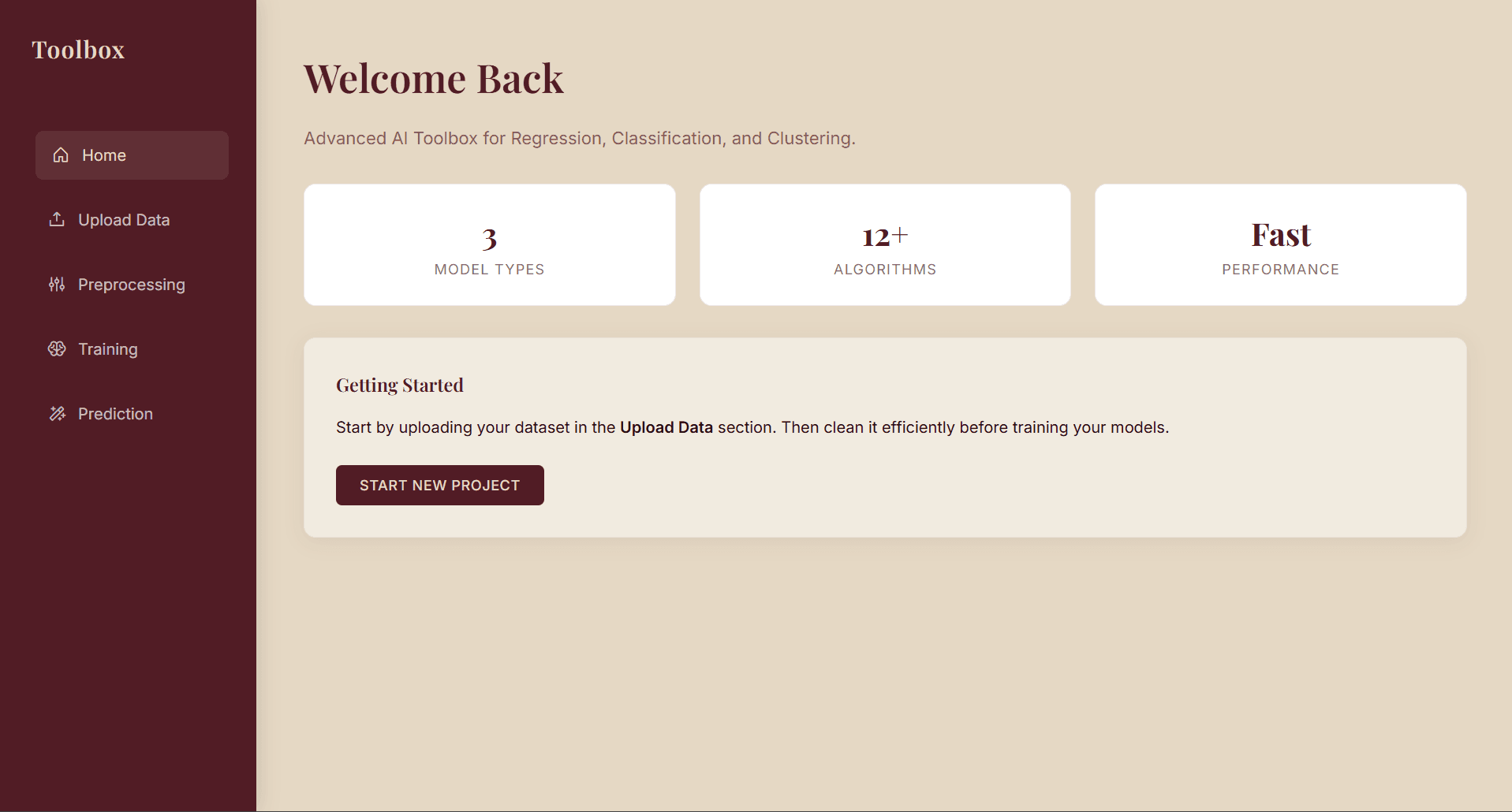
The visual is an existing screenshot of the application from the public repository. The repository contains both the library modules and the application implementation.
The project demonstrates a structured experimentation workflow. It does not claim a universal best model or a benchmark result across unrelated datasets.
Limitations
Evaluation is specific to the dataset, target, split strategy, and metric. Good results on one experiment do not establish performance on new data.
Not every library module is available in the application. Data quality, leakage checks, and appropriate validation still require judgment from the person running the experiment.
Explore the project
The source link opens AI-ML-toolbox, where the application and the underlying modules can be reviewed together.